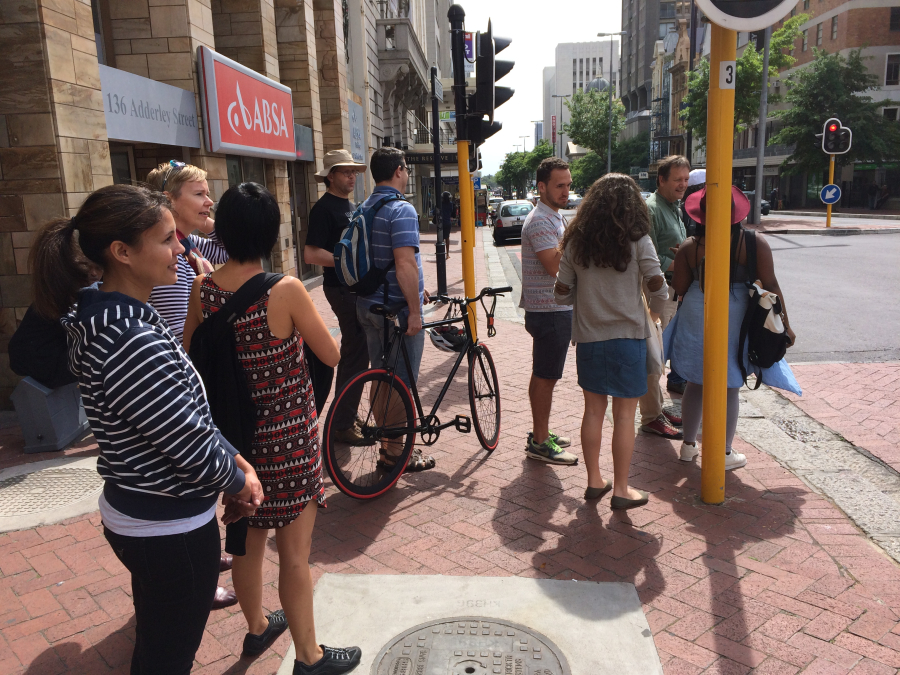
On Saturday 15 October, a group of urban enthusiasts met at the intersection of Wale Street and St Georges Mall for the latest edition in Open Streets Cape Town’s (OSCT) Talking Streets series. The topic: “Car-free CBD ... say what?!”
With the city's diverse mix of road users, is it possible for Cape Town to have a car-free CBD? Is it something we want? And, if so, how do we get there? CCID staff writer Brent Smith went along for the chat.
OSCT chairperson Rory Williams led the discussion with consultant Didintle Ntsie. It started with them asking each person present to pick an alternate persona from a hat. Cyclists became motorists; motorists became parents pushing strollers; walkers became informal traders with heavy trolleys. And all had to answer the question: “What works and what doesn’t when I move around the CBD?”
The discussion that followed was an interesting mix of opinions. For example, a "motorist' found Adderley Street slow to navigate due to the high number of traffic lights and the "chaos" caused by vendors. A "trolley pusher" found it challenging to turn from Wale into Adderley because of the low visibility and the lack of awareness of other road users. A "cyclist" felt her presence irritated motorists; another that the cycle lane wasn't conducive to building momentum on a bike.
The walk and talk continued up Castle Street, into Burg Street and into Greenmarket Square, before ending where it began. Uneven surfaces en route were common, and a hindrance for personas (real and assumed!) in wheelchairs or wearing heels.
Those who gathered agreed that the CBD has several, varied route options, but that there isn't a single "perfect" road for all users and situations.
An interesting observation was that people perceive the CBD's north-south routes (Adderley, Bree etc) differently from those that run from east to west. The latter are “underrated” but strong connectors. For instance, Longmarket Street was once a crucial route for those travelling between Bo-Kaap and District Six. Today, the lack of activity in the latter area and the difficulty in crossing the major north-south streets make it less appealing.
For more such observations, read OSCT's account of the day.
So, can the CBD become car free? The simple answer: not overnight, as it would alienate many. The group envisioned closing streets to cars during lunchtime or a series of Open Streets Days as a starting point to behavioural change.
Permanent pedestrianisation of a street requires mitigating the impact on the surrounding area. For example, closing Long Street in tandem with making Loop Street a two-way could allay fears of increased traffic on other routes. And it could bring more life to Loop Street to boot.
In the meantime, several interventions could improve the current state of affairs in pedestrian spaces. These include reducing "clutter" such as redundant signage in walkways; better signage for demarcating walkways and cycle lanes; the levelling of surfaces where possible; and the provision of storage for informal traders.
Already, there are interventions in place that improve pedestrian safety in the CBD. These include the City's bump-out project and its installation of audio-tactile push-buttons that aid pedestrians with special needs.
In conclusion, there is a need to identify the rhythms of different road users and to try to synchronise them. If, for example, parking were available on the outskirts of the CBD, and in walking/cycling distance from the centre, a car-free downtown could take shape. This would have a knock-on effect in making MyCiTi bus services that currently share the road with cars more reliable. The space used for off-street parking could also then free up for something else.
How much road space do different road users take up? Here’s your answer:

Image via the Independent
Open Streets returns to the CBD on 15 January 2017. This is part of a series of four Open Streets Days that will take place over a six-month period. Find out more at http://openstreets.org.za.