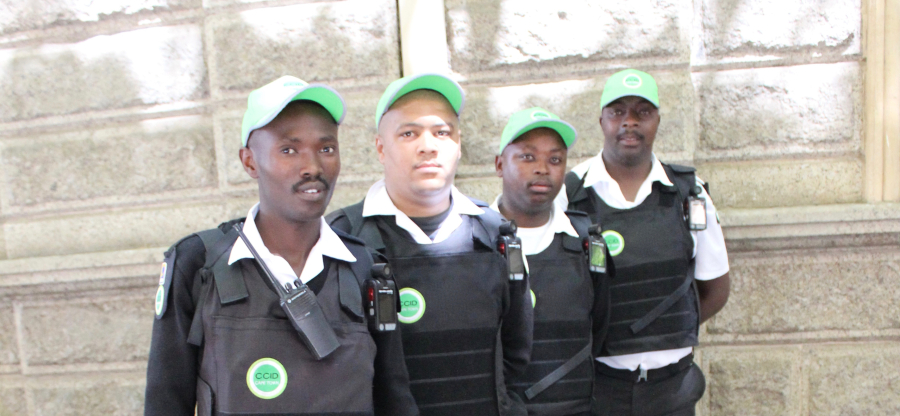
Following a highly successful pilot project launched at the end of 2015, the CCID over the past few months has been equipping all its on-duty public safety officers (PSOs) with body-worn video (BWV) camera units.
With the full rollout to be completed within the next few weeks, the implementation of the system has exceeded all expectations in de-escalating potentially violent situations, preventing crime and modifying the behaviour both of members of the public as well as the PSOs.
Explains Muneeb Hendricks, CCID Safety & Security manager: “BWV cameras are cutting-edge technology for law enforcement services globally and their aim, in a nutshell, is to keep everyone on the side of the law, honest and well-behaved. It’s about both behaviour modification and accountability.
To see exactly what the camera is able to capture, please view this demonstration with Muneeb Hendricks.
“The BWV cameras are as effective at improving service delivery by our public safety officers as they are at reducing public crime and violence levels in areas where they are deployed, because everybody’s actions are recorded.
“From the CCID’s point of view, we want to render the highest quality, efficient service that applies all laws and regulations equally and takes the guesswork out of incident reporting.”
The rollout of the system has seen all 230 of the CCID’s PSOs being trained in the operation of the units. Around 70 PSOs are always on duty throughout the Central City, and the BWVs are designed for round-the-clock deployment. They are equipped with infrared recording capabilities for after dark, laser guides to indicate where the cameras are pointing and the ability to record video, sound and rapid multiple still images.
Hendricks says the decision to extend the pilot project was an easy one: “Cameras are extremely effective as an immediate behaviour modification tool. If people know they’re being recorded, they’re unlikely to escalate to violence in a potentially volatile situation. This applies to both the public and the officers themselves.
“They are also extremely effective in targeting specific types of crime, both covertly and overtly. From a covert crime prevention point of view, if you know, for instance, that drug dealing is happening in a certain area, officers can record from a distance and with the footage we can compile an evidence dossier. Overtly, we deploy the BWV officers in the hotspot and the drug dealers will leave because they won’t want to conduct business in full view of a video camera, the footage of which can be used in evidence by our law enforcement partners at the City and the South African Police Service.”
Hendricks says a particularly important aspect of the BWV deployment is to ensure that the rights of the public are protected.
“The use of BWVs has substantially reduced the number of investigations conducted when we receive complaints against our PSOs. We have always investigated, and will continue to investigate, every complaint we receive, but cameras take the ‘he said, she said’ aspect out of the equation and we’ve been able to resolve cases far more quickly.
“They have been particularly effective in resolving ‘stop and search’ complaints against our own PSOs as well as our Law Enforcement officer partners at the City when allegations have been made that money or personal possessions have been taken; as well as complaints that our own PSOs have in any way acted in an untoward and possibly even illegal manner.”
Tasso Evangelinos, the CCID’s chief executive officer, says a Digital Evidence Management System (DEMS) has also been purchased along with the cameras to enable all footage from incidents to be stored to protect the chain of evidence.
“This system allows us to securely store, manage and export digital footage as required,” says Evangelinos “and only the administrator of the system, not the user, can delete footage. So if the user has misbehaved on duty, that person cannot delete the footage.”
The DEMS system also uses encryption software so that if the file is copied, it cannot be viewed on another system.
Hendricks says all footage captured will remain the property of and in safekeeping with the CCID. “We will of course make it available in criminal cases as required and it will always be available to the City of Cape Town Law Enforcement agencies and the South African Police Service.”
He believes the BWV rollout to all PSOs in the Central City will have a dramatic behavioural effect on both the public and officers to ensure compliance with all laws and regulations.
“The Cape Town CCID is leading the international best-practice charge in South Africa in terms of safeguarding all members of the public in our footprint and ensuring that their rights are protected when they interact with our public safety officials.
“Ultimately this will make the streets of Cape Town’s CBD safer for everyone.”
Pictured above are public safety officers (left to right) Mzuvukile Siyazi, Brendon Booysen, Msimelelo Mgolombane and Zipho Nqata.