
The Cape Town Central City Improvement District (CCID) was set up nearly 13 years ago to transform the CBD into a safe, clean and caring environment. And while keeping focused on the basic campaigns, the CCID constantly assesses developing situations and works to meet new challenges.
One of the ways in which we rise to new challenges, is to conceptualise, test and roll out public awareness campaigns, which are not only freely available to our stakeholders but supplied as open-source material to other centres across the country.
“We have achieved our original mandate to establish the Cape Town Central City as having South Africa’s most successful CBD,” says the CCID’s chief operations officer, Tasso Evangelinos. “But given tough economic conditions and many social challenges (from joblessness to rapid urbanisation), you can never say your work is done.”
Cape Town’s Central City now attracts over 350 000 commuters every day, drawn by its many facilities that range from business hubs to government offices, and educational institutes to hospitals. Hundreds of thousands of visitors – for business and travel – plus people simply seeking to survive and to grow a better life, cross its streets every year.
“We constantly have to develop innovative ways to add value through service delivery on the ground – in the way we interact with our stakeholders and partners as well as how we communicate with all the people we are mandated to help,” says Tasso.
A number of the campaigns being rolled out in the area have evolved from best practice examples gleaned from overseas and translated into workable solutions in a uniquely South African situation, while others are the brainchildren of the on-the-ground team. Exercising every opportunity, the campaigns include well-designed traditional media such as brochures and posters, complemented by digital media, in turn underpinned by tools such as Google Analytics reports.
Campaigns have ranged from waging war on waste to highlighting public safety initiatives. Depending on the requirements, each campaign usually falls within a specific department – Safety & Security, Urban Management or Social Development.

Stay safe: Stash it, don’t flash it

This is the catchy tagline of a campaign that has been hugely successful in raising public awareness about not leaving valuables in plain sight in vehicles; in other words, making the public aware of situations that could arise, just as they would in any foreign city.
Aimed mainly at motorists who park in the CBD, a retro-cool poster was designed to remind drivers and passengers that even a pair of shoes or a small bag left on a seat (let alone a laptop) could result in smashed windows and plenty of hassle and expense at the end of a busy day.
Launched in December last year, 800 street pole posters were installed in the CBD over a three-month period to publicise this campaign. The CCID also approached parking garages for their support, with Growthpoint Properties being the first to come to the party, putting up posters in their Picbel Parkade and Golden Acre centres. Another 300 posters were put up on retail outlet windows.

Keep it clean: nipping waste in the butt

Along with the importation of the latest cleaning equipment such as its trademark red sweepers seen on the streets since March this year, the CCID’s Urban Management team has declared war on ciggie butts on clean pavements. In 2011, its pilot programme to place 100 cigarette bins in strategic public places was so successful that an additional 200 bins were ordered – also incorporating a more robust, four-sided design. In a Cape Town first, permission has been obtained from the City for these to carry sponsored messaging.
But what do you do when no ciggie bins are in sight? There’s still no excuse! The latest must-have accessory for litter-conscious locals is a neat smoker’s pouch. With the cool lime and white colours on the outside, inside is a fireproof lining that locks in both waste and odour. The pouch has been designed to fit easily into a pocket or handbag until its stompie and ash contents can be disposed of appropriately.
From an initial large order of 35 000, 10 000 pouches have already been distributed at traffic intersections during peak traffic hours. Another 10 000 were snapped up during lunch hours, and the final 15 000 were distributed at office buildings. These handy little accessories also carry the CCID’s mobile security number.
“The ultimate objective of this project is not only to reduce litter, but to heighten the level of environmental awareness within the Central City through an accompanying campaign that targets retailers and corporates and deals with broader issues such as illegal dumping,” says Richard Beesley, manager of the CCID’s Urban Management team. “Keeping the litter-prevention message constantly in the public eye is essential to addressing environmental pollution in a proactive way.”
Bay watch
Ever mindful of the Central City’s need to develop and encourage the use of public transport, the CCID and the City have also always been attentive to the needs of disabled drivers and motorcyclists. Recent research undertaken by the CCID revealed that over 140 new motorcycle bays and at least 42 bays for disabled drivers could be created – without taking away any existing bays. With the full recommended rollout currently under review by the City, a number of new disabled and motorcycle bays have already been demarcated by the Roads Department across the CBD.
Street [numbering] wise
How often have you found yourself at an intersection in town, looking for an address but not sure which way to go? And if it’s tough for locals, imagine what it may be like for tourists and other visitors?
A first for a CBD in South Africa (and the only one to date), the Central City is following the example of numerous cities abroad. In 2012 the CCID researched a street names and numbering project based on producing more informative street signs incorporating street numbers. In collaboration with the City’s Roads Department, the first of these have now been rolled out at 17 intersections along Bree Street, with Loop and Long streets next in line for their makeovers.
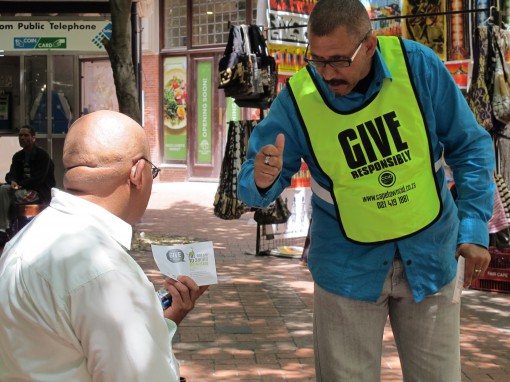
Show you care: Give Responsibly

Four years ago, the CCID’s Social Development department began promoting awareness about responsible giving and the detrimental long-term effects of ad hoc donations to people begging on the streets. It was particularly aware that many Capetonians wanted to help those clearly in dire straits and to this end it devised the Give Responsibly campaign. Initially encouraging people to donate time, money and goods (such as food and clothing) to registered NGOs rather than giving handouts, the campaign has evolved significantly since December 2012 when it introduced a quick and easy way to make an online donation too. Each SMS transfers a R10 donation to the CCID's NGO partners. These manage proven interventions, ranging from job rehabilitation projects to night shelters.
The campaign was recently enhanced by real-life stories printed on brochures with vinyl stickers, accompanied by flyers handed out at traffic intersections and the erection of 800 eye-catching street pole posters across the CBD. Visit the website: www.giveresponsibly.co.za.
Watch this space: doing it together
A joint initiative of the CCID’s Social Development and Safety & Security departments is a brand-new campaign to be launched soon that reaffirms the Give Responsibly message as an alternative to giving to people directly on the streets. It will also give advice on how to deal with the situation when begging becomes aggressive, should you encounter this behaviour. This public awareness campaign with info on giving responsibly as well as safety tips, includes a brochure, a triangular table talker ideal for restaurants and retailers, and a decal for shop windows to strengthen the message.
Information at hand
A handy Useful Numbers fridge magnet has also been produced by the CCID, with over 5 000 already distributed to people ranging from retailers to local residents. Offering up not only the CCID’s 24-hour control centre number along with numbers for services provided by the City of Cape Town, the reverse comes with added-value scanable QR codes of these numbers for smartphone users. Download the document here, and read “Who are you going to call?” for more about who does what in the Central City and who to call when you have a specific problem.
Would you like to know more?
For more information on any of these campaigns, or to obtain your own collateral, please contact Aziza Patandin on 021 286 0846 or email aziza.patandin@capetownccid.org. To see open source material as it is made available, go to Campaigns under About Us on our website.
This article first appeared in the August issue of City Views: Cape Town Central City in focus. Read it online.