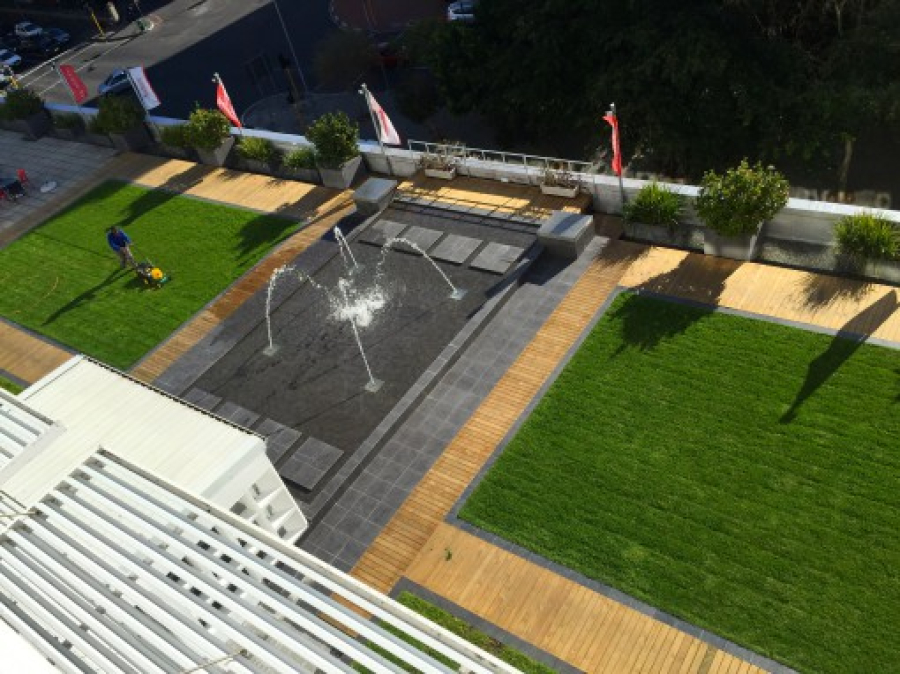
A fashion school in the Central City is showing the way for sustainable development. City Views spoke to FEDISA director and “haute culturalist” Allen Leroux about his transformation of the campus’s rooftop into a literal urban oasis.
The next time you’re high up in a tall Cape Town CBD building, take a look out the window. What do you see? Rooftops covered in gravel, adorned with satellite dishes and air-con ducts? Imagine how different these vast spaces, often the size of entire city blocks, could be.
“If you were in Manhattan,” says Allen Leroux, “you would see beautiful gardens in the middle of the city.”
FEDISA’s director was inspired by this to create his own rooftop garden, at the institution’s campus off Buitengracht. Perhaps you can see it amid the grey from your window.
“In December 2011, when we took possession of this building,” he says, “we inherited a 1 000m2 rooftop deck, which is accessed from the third floor. When we arrived, there was just gravel and paving stones. It was a complete waste of space.”
Today, you walk out onto real lawn, and hear the sound of running water.
Planting a seed
The rooftop started to come to life with the addition of fountains, which were installed by August 2012. “Being a Pisces, I’m big on water,” quips Allen.
But there are weight considerations when working on a rooftop. So how did Allen and his team navigate this? “We built the fountains over high-density polystyrene blocks covered in concrete skin, with a waterproofing membrane on top, and finally tiling on top of that.”
Fourteen trees and shrubs were then brought up through the college’s goods elevator.
First signs of growth
Two years after the initial beautification, at the end of 2014, Allen and co installed the two lawns that make up 300m2 of the rooftop space. “We did a lot of research, got a lot of quotes, and got a lot of people telling us it couldn’t be done, but I’m not the kind of person who believes anything is impossible. So I did it entirely with my own maintenance staff – Roy and Clarens Zweni and Moses Magwashu – and Ncedile Nyama, who was initially employed as a temporary cleaner.”
Weight came into play again. “This building was originally constructed in the 1960s as a showroom for a car dealership and we had an engineer’s report before we did anything that confirmed the strength of the structure could support several additional storeys. But just in case, I bought enormous bags of waste polystyrene to build out the structure of the lawn. River sand went on top to hold it in place. The rationale behind the polystyrene was partially weight compensation and partially to save on top soils.”
But the first thing they did was to start cleaning the dusty gravel that had covered the rooftop by building a rudimentary sifting system. Following that, they brought in cinderblocks to create the borders of the beds into which the lawns would eventually be planted. Waterproofing membranes were laid, and the gravel reinstated. A geotextile, which Allen bought directly from a wholesaler, was placed over this. Then came the polystyrene and river sand. The leftover cinderblocks were used as planters for small shrubs around the lawns. The top soils were brought in – all six tons of it – via the hardworking goods elevator. “Over three days, we transported that soil up to the deck in wheelie bins.”
The lawn arrived at 16h50 on a Friday evening, and by 19h30, FEDISA had a rooftop garden. As soon as those lawns went in, the irrigation went on to water the sods. Allen built this system himself. “The internet taught us all these things,” he says. “It’s not a case of just signing a cheque and getting someone else to do it at enormous expense. Sometimes you just have to put a little bit of blood, sweat and tears in yourself, and you can achieve amazing things on a very limited budget.”
Water wise
“Our main fountain needs cleaning quite often because it’s become a favourite spot of all the birds in the area, including two large hadidas.”
Originally, the water from the fountain was drained and pumped down to the street. The fountains would have to be refilled after cleaning. “I didn’t like this,” Allen continues, “especially as we also needed a lot of water to keep the lawns growing. The biggest question we have, and that any business should have, is: how can we conserve resources?”
So, with his fashion degree, he designed an eight-valve distribution system, which now takes the waste water out of the fountain and sends it around the entire garden. Where the garden previously took three hours to water by hose, it now takes all of 15 to 20 minutes once a week.
Finishing touches
“The quotes we received for tiling the deck were outrageous,” says Allen. “Hence the director of the institution learnt to do it himself – and I’m now the proud owner of my own tile cutter.”
He was able to teach his team to tile as well. Together, they installed a beautiful border around the lawns. “All the maintenance guys have now acquired additional skills that they use in their communities.”
The final step was to level it all up. So Allen went back to Google – and learned how to install decking. “Ncedile and I eventually built this deck for a fifth of the quotes, with 4.2 tons of wood – treated so that it lasts for 25 years. Each slat has six to eight screws and it took eight weeks to complete. I worked from nine in the morning till one every day. Then had a shower and was director again until five.”
The main event
Allen says that prior to this exercise, he had “no more gardening experience than any other suburban boy whose dad made him mow the lawn”.
It’s thanks to his efforts that FEDISA’s spectacular second-floor rooftop has become a sought-after event space. On First Thursdays, the institution hosts “Fashion Flashes”, where second-year students model their outfits. Allen says up to 500 members of the public regularly enjoy this event. Why not pop round on 3 September and have a look for yourself?
FEDISA: 81 Church St | www.fedisa.co.za, 021 424 0975
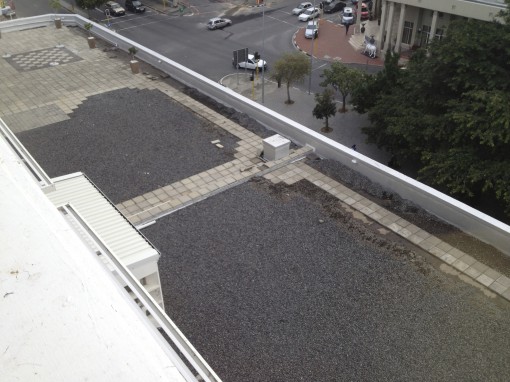
The rooftop in December 2011
The Smart Building Handbook
The City of Cape Town published its Smart Building Handbook in 2012. It provides practical information on energy-efficient technologies, materials and design criteria, and promotes resource-efficient building practices, which can reduce the impact that buildings have on the environment as well as the cost of running them.
You can download the Smart Building Handbook at www.capetown.gov.za/en/EnvironmentalResourceManagement/publications/Pages/GreenBuilding.aspx
Sustainability in other cities
Cities will be home to an estimated 70% of the world’s population by 2050 and they will need to operate differently from now. Here are those leading the way.
- Rooftops on new buildings in commercial zones in French cities must either be partially covered in gardens or solar panels.
- Toronto adopted a bylaw in 2009 mandating green roofs in industrial and residential buildings.
- Bogota’s Transmilenio bus rapid transit system, an inspiration for MyCiTi, carries 70% of the population through the city each day, resulting in an emissions reduction of 350 000 tons per year since it was implemented. The system also aims to completely convert to hybrid and electric buses by 2024.
- In 2002, San Francisco started its Zero Waste programme. Since then it has achieved an 80% landfill diversion rate.
- The high Line is a 2.33km Manhattan park built on an elevated section of a disused railroad track.
- Munich has targeted a 100% clean electricity supply by 2025. To this end, Stadtwerke München, the city-owned utility, has invested in offshore wind farms in the North Sea.
This article first appeared in the August/September 2015 issue of City Views. Read it online.