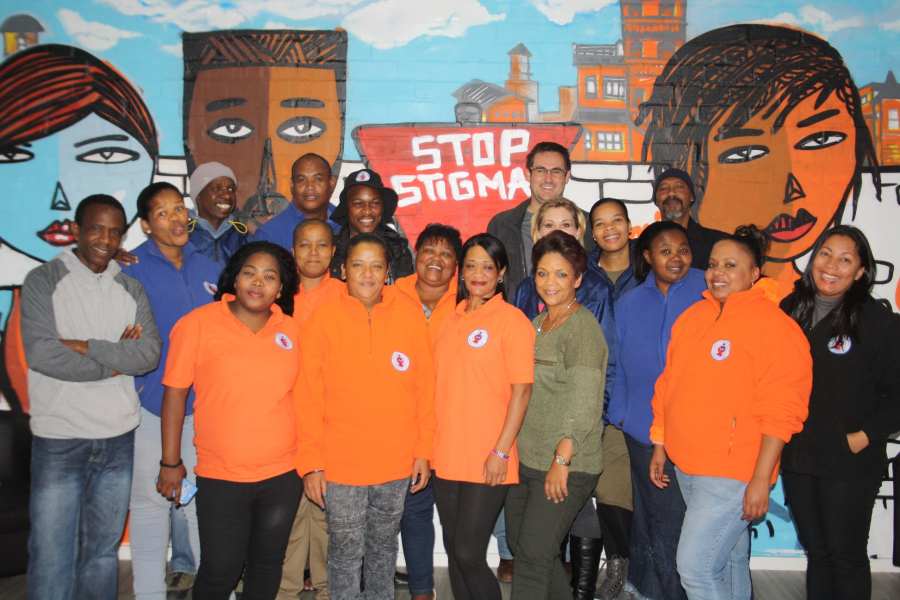
The Cape Town Central City Improvement District’s (CCID) Social Development department welcomes TB/HIV Care's new drop-in centre to the area.
Founded as the Nelspoort After Care Committee in March 1929, TB/HIV Care has been helping Capetonians for nearly 90 years. The organisation started out treating people with TB, of course, and in the mid-2000s, as antiretroviral treatment rolled out, expanded its role to include community-based support for patients with HIV. Since 2011, TB/HIV Care has become a major provider of health services to “key populations”; ie those most at risk of HIV infection.
TB/HIV Care has offered health services in the Cape Town Central City through its mobile clinics since 2007. This year, it established a drop-in centre, situated on Rose Street in De Waterkant, just outside the boundaries of the CCID. Among other services provided to key populations such as sex workers, the drop-in centre provides “harm reduction” to help prevent and reduce the spread of HIV among people who inject drugs (PWID). This is part of TB/HIV Care's Step Up project, which offers a package of essential HIV and other wellness services recommended by the World Health Organisation (WHO) to PWID. The project, which enjoys the backing of the Western Cape Department of Health, includes the provision of sterile needles and syringes as well as condoms, HIV counselling and testing, TB and STI screening, wound care, and behaviour change interventions tailored to injecting, overdose prevention and the sexual risks of PWID.
The CCID’s fieldworkers are able to refer clients to the drop-in centre to access these services, as well as an on-site social worker and psychosocial counsellor, and a safe space where clients can access shower facilities and a chill-out area.
Says CCID Social Development manager Pat Eddy: “Many of our clients living on the streets are injecting drugs, and the harm reduction services provided by the Step Up project allows this group to receive appropriate HIV counselling and testing, which greatly assists in reducing the spread of HIV on the streets.”
On its website, the WHO states: “Injecting drug use is one of the fastest growing routes of HIV infection in many parts of the world, primarily because needles, syringes and drug preparation equipment are frequently shared, enabling rapid spread of the virus. Harm reduction is the application of good public health principles to the problem of HIV. It is a phrase used to describe a concept aiming to prevent or reduce negative health consequences associated with certain behaviours.”
Additionally, TB/HIV Care’s PWID team (Step Up) is supported by the Cape Town Network of People who Use Drugs (CANPUD), which regularly collects used injecting equipment in the areas where Step Up provides services. Step Up then disposes of these according to medical regulations. To further prevent “litter” of needles in public spaces, the NPO encourages PWIDs to return their used injecting equipment to outreach teams or the centre, and provides them with “sharps” containers to this end.
The Western Cape Government Department of Health supports the project, acknowledging that taking away someone’s safe injecting equipment won’t stop them from using drugs, but will make it harder for them to stay as safe and healthy as possible.
To find out more about the CCID’s Social Development department, click here.
To view and subscribe to our monthly newsletter, click here.