
Covid-19 has wrought havoc on leisure and business tourism to Cape Town, with most of the CBD's 40-odd hotels closed. This special report was compiled by industry experts, HTI Consulting.
In 2019, the World Tourism Organisation (WTO) estimates that tourism grew globally by 4 %. Africa and the Middle East led the charge, with growth of 6 % and 7 % respectively. In 2020 however, the impact of Covid-19 has been severe, with the WTO indicating a decline in tourism of 22 % during the first quarter of 2020. This equates to 67 million fewer tourists and a loss of USD 80 billion in exports.
Africa has not escaped the negative trend with a decline of 13 % over the first quarter. This is small when compared to 35 % in the Asia Pacific region. However, while this region is already in the recovery phase from the virus, its impact on Africa only started during March of 2020.
IMPACT ON TOURISM
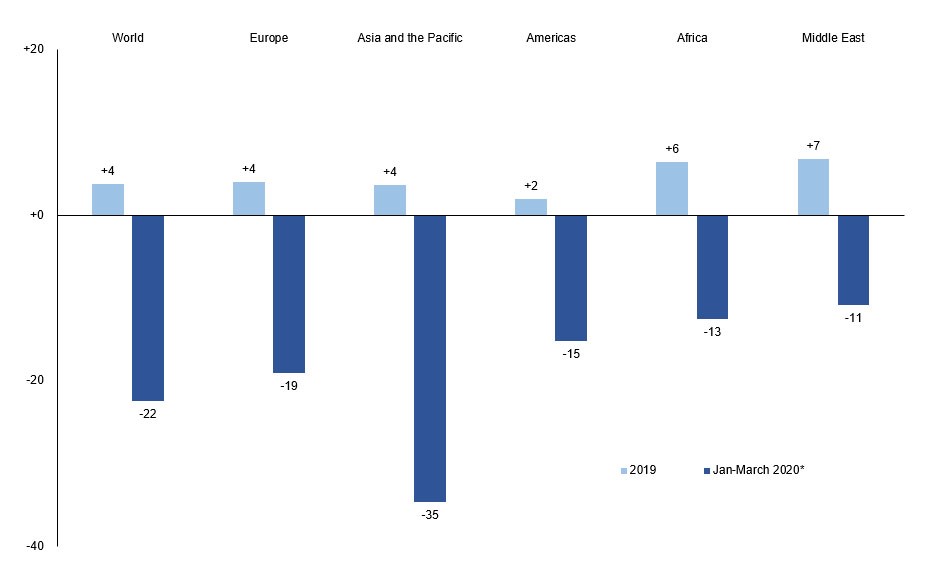
SOURCE: UNWTO
Projections from the WTO indicate that by the end of 2020, a 60 % to 80 % decline in international tourism could be experienced when compared to 2019.
THE SOUTH AFRICAN CONTEXT
Tourism was showing an extremely positive recovery in South Africa at the start of 2020. For the first two months of the year, total arrivals increased by 1.5 % with overseas arrivals showing growth of 2.4 %. Given the overall decline in tourism in 2019 of 2.3 % (-2.2 % from overseas arrivals), and the decline of 4.9 % (overseas market) in the first two months of 2019, the return to growth was extremely positive.
The global pandemic started to impact on arrivals to South Africa in March 2020 with a 33 % decline in the number of tourists compared to February. The year on year first quarter decline for 2020 was therefore -10.2 %. Considering that South Africa only entered Lockdown on 26 March 2020, this decline is even more significant.
THE IMPACT OF COVID-19 ON TOURISM TO SA

SOURCE: StatsSA
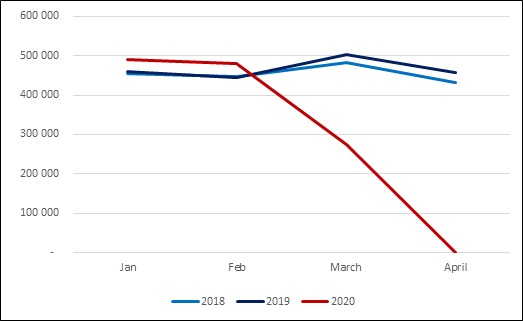
The impact on Cape Town, while not measured by StatsSA, can be demonstrated by arrivals at Cape Town International Airport, which declined sharply in March, with a total of 243 arrivals in April 2020 as borders were closed at the end of March stopping all international travel other than the repatriation of nationals.
ARRIVALS TO CT INTERNATIONAL AIRPORT 2018 – 2020
SOURCE: Airports Company South Africa
HOTEL BOOKINGS COLLAPSE
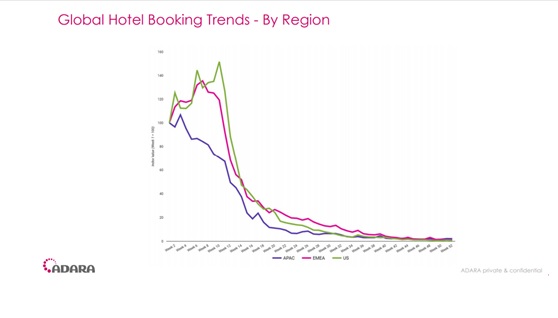
Considering the decline in tourism and the closure of borders globally, it’s no surprise that hotel bookings have collapsed. According to Adara, the global hotel industry lost approximately 75 % of its bookings by week 12 of 2020, in relation to the same time period in 2019.
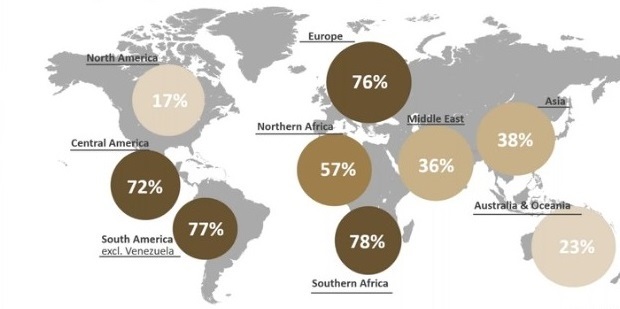
The above led to widespread hotel closures around the world, with up to 76 % of hotels within hotel research company STR's portfolio being closed in Europe and 78 % in southern Africa. In South Africa, STR estimates that up to 90 % of hotels within its portfolio were closed in April.
CLOSURE OF HOTELS IN THE STR PORTFOLIO AS OF APRIL 2020
SOURCE: STR
The picture in Cape Town is similar, with a large proportion of hotels being closed. Under normal operating conditions, there are an estimated 10 500 rooms that contribute data towards STR (77 properties) in Cape Town. An estimated 40 % of these are located in the footprint of the Cape Town Central City Improvement District. In May 2020, once the impact of Covid-19 was being felt, only 16 properties contributed data to STR (2 073 rooms), indicating that the majority of the properties were closed.
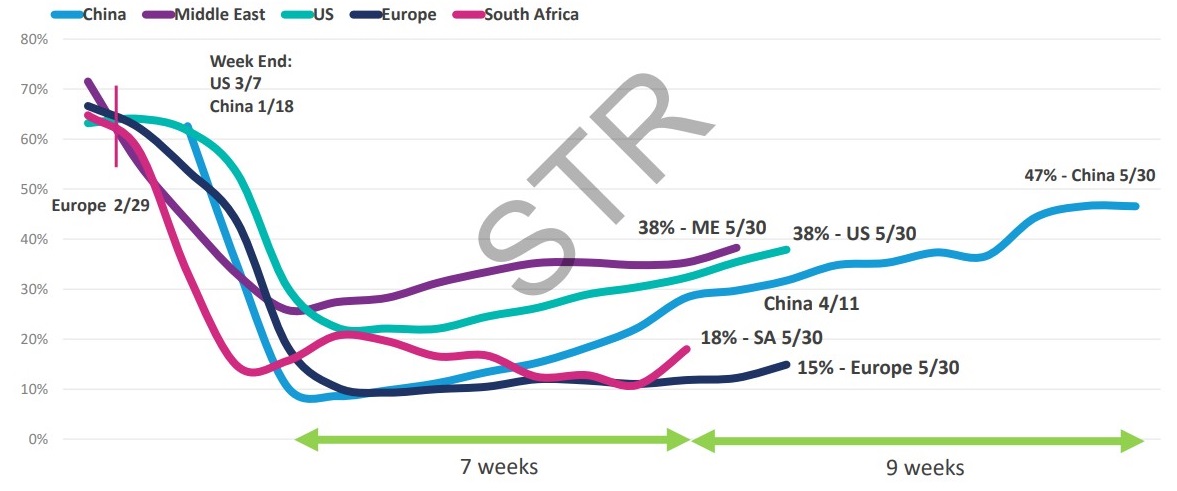
The performance benchmarks across the globe have been dismal since the impact of the virus. Occupancy declined immediately once borders closed and travel ceased. South Africa has not escaped the trend with an occupancy of 16.8% in May 2020. Given this occupancy is for open hotels only, the rate drops to just 4% if all participating STR hotels are considered.
OCCUPANCY PERCENTAGE OF OPEN HOTELS
SOURCE: STR
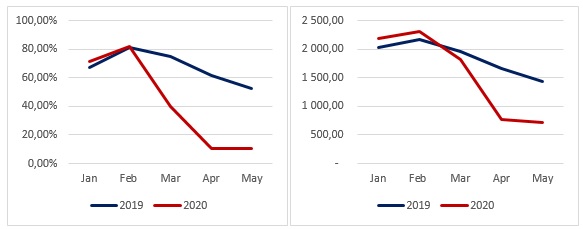
In Cape Town, the impact of the virus is frustrating given that the market was showing signs of recovery after the recent water crisis and large increases in supply. In 2019, the city as a whole achieved an occupancy of 65.3 % and an ADR of R1 784 which represented growth of 1.9%. While performance of hotels in the CCID footprint in the CBD remained stagnant in 2019 at an estimated occupancy of 67 % and an ADR of R1 250, this was extremely positive considering that over 980 rooms entered this node alone between 2017 and the end of 2019, and an additional 400 rooms entered the market at the V&A Waterfront and its surrounds. The recovery continued into 2020 with positive upticks in both occupancy and ADR in January and February. However, from March, the impact of the virus saw both measurements show a strong decline.
CAPE TOWN OCCUPANCY CAPE TOWN ADR
PERFORMANCE PERFORMANCE
SOURCE: STR
At the time of writing, the Government has just announced that accommodation for business tourism can re-open under strict hygiene protocols. While this is positive, restricted movement throughout the country will limit the extent to which accommodation establishments can benefit. Airlines are, however, taking to the skies to accommodate business travellers and business visitors are expected to start trickling back to Cape Town.
Recovery in the market is expected to be slow, but it is still expected to occur with 2019 levels expected to be reached by the end of 2022/early 2023. Global markets are already showing some positive recovery, notably China where the occupancy of open hotels has reached 47 %.
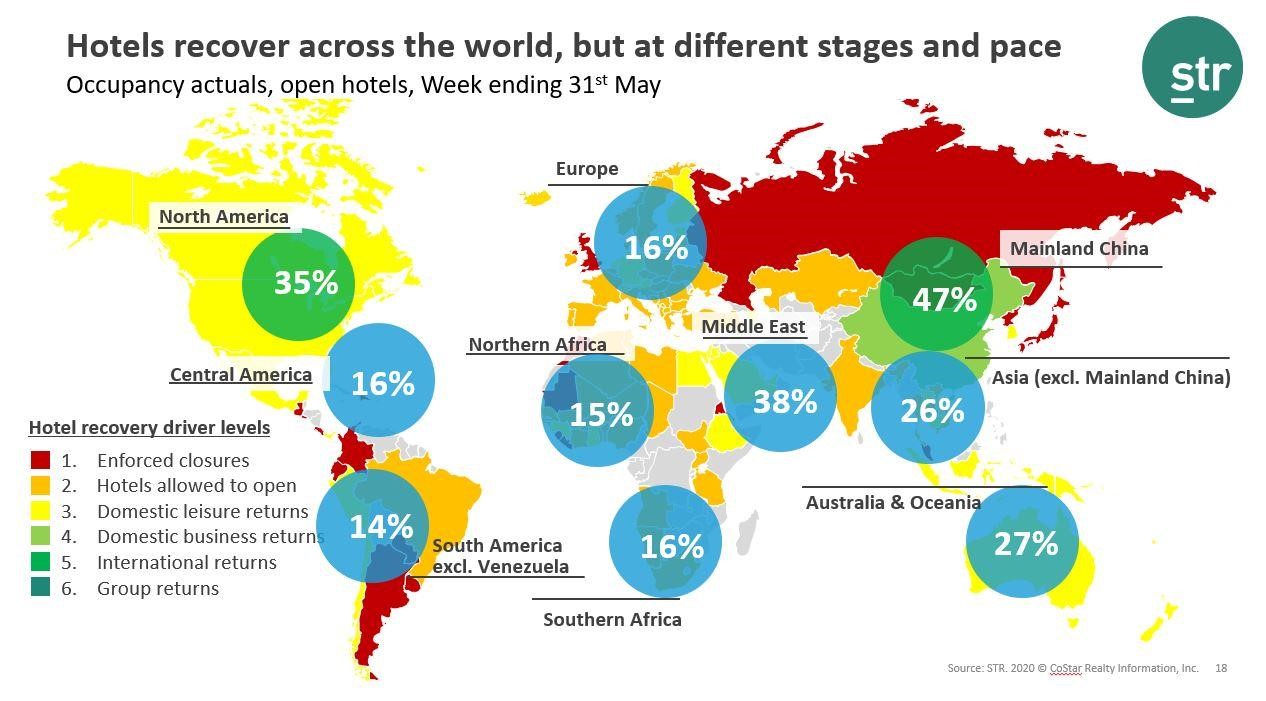
Similar trends are likely to follow in South Africa. Whilst things remain very challenging and uncertain currently, Cape Town has always been a resilient destination with various strong demand generators contributing to the success of the tourism industry: conference, events business tourism, leisure tourism and medical tourism. This will enable Cape Town to continue to be resilient through the remaining months of the crisis and will allow it to bounce back quicker than other destinations that are less diverse.
IMAGES: STR, Airports Company South Africa, Adara, UNWTO, StatsSA