From mobile apps that make life a little easier to tools once considered futuristic, here are 14 examples of innovations available in the Cape Town CBD that make life easier, safer and a whole lot more fun. Some of these were even designed here.

1. Body-worn video (BWV) cameras
The Cape Town Central City Improvement District (CCID) has rolled out 75 BWVs for its public safety officers (PSOs) – enough to cover a full shift rotation. These BWVs have infrared recording capabilities for after dark. They come equipped with laser guides and can record video, sound and rapid stills for evidence. City-run CCTV cameras have been a fixture in the CBD for many years, but the CCID is now upping the ante on crime prevention, with international best-practice standards.
2. A mobile listing of CBD venues
As with all forward-thinking web design, the CCID’s website is mobile first, and puts the CBD’s spectrum of retailers and service providers straight onto your phone or tablet. (And of course your desktop, if you still have one!) It features venues, mapped and with their contact info, in eight colour-coded categories.
www.capetownccid.org
3. Accessible tech at Central Library
Funded by the US Consulate, Central Library relaunched the R3.5 million American Corner in 2015. There you’ll find iPads, MacBooks, digital cameras, video production equipment and a range of creative software. It also features high-speed Wi-Fi, a sound recording studio and green screen technology. The main attraction is the Makerspace, a hands-on incubation lab where the public can design and create products.
Old Drill Hall, cnr Darling and Parade streets | 021 444 0209/12
4. Free Wi-Fi
Isabelo installed its first Cape Town Smart Bench on the corner of Adderley and Wale streets. It partnered with the Cape Town Partnership and Wesgro to make this a reality. The bench, described as a “plug and play solution for public spaces”, is a Wi-Fi hotspot where you can surf the net and also charge your mobile device. It will soon be moved elsewhere in the CBD. Free Wi-Fi is also available in The Company’s Garden and Church Square.
5. Cashless parking payments
Street Parking Solutions (SPS) manages on-street parking in the CBD on behalf of the City of Cape Town. Parking marshals employed by SPS carry point-of-sale devices. These enable motorists to pay for kerbside parking with MasterCard, Visa, American Express or myconnect cards, or via the SnapScan app.
6. Robotic surgery
Christiaan Barnard Memorial Hospital was one of the first Netcare facilities to receive da Vinci Si robotic technology in South Africa. The system assists surgeons in performing intricate procedures.
7. Augmented reality
Many Capetonians got their first taste of augmented reality via the mobile game Pokémon GO. But did you know there’s a CBD-based company harnessing the technology, as well as virtual reality, for corporate marketing campaigns? If you’ve used Pick n Pay’s Super Animals app, then you’re familiar with the work of Sea Monster, a company blazing a trail into a new hyper-visual world.
3rd Floor, 75 Harrington Street | www.seamonster.co.za | 021 461 0365

8. Cashless bus fare payments
MyCiTi uses a card-based fare system rather than cash. To board a bus or enter a station, hold your myconnect card against a validator. Do the same when exiting. The fare for your journey is then deducted from your credit.

9. Wi-Fi on MyCiTi buses
MyCiTi is currently offering passengers on some Central City buses 50MB of free internet access per day. This is a pilot for a project it is looking to roll out across all its routes.

10. 3D printing at Cape Craft and Design Institute (CCDI) and Woodheads
3D printing has revolutionised prototyping. Industrial designers can now “print” their digital drawings in layers of ABS plastic. This means that there is a physical render to work with early in a design process. The CCDI and Woodheads both offer 3D printing services.
CCDI: 2nd Floor, Harrington House, 37 Barrack St | www.ccdi.org.za | 021 461 1488
Woodheads: 29 Caledon St | www.woodheads.co.za | 021 461 7185
11. Development Application Management System (DAMS) and 3D building modelling
These City initiatives are changing how developers and planners interact with the built environment. DAMS allows for electronic submission and processing of development applications. Simultaneous scrutiny of the applications means that 97% of them are now processed on time. Meanwhile, the City’s Development Information and GIS Department has acquired thousands of digital 3D building models for the Cape Town CBD. This makes it easier for planners to visualise the area. Find more here: www.capetown.gov.za/en/Planningportal
12. 360 virtual tours
Panoman uses Google Maps technology to replicate Street View inside hotels, shops and restaurants. It allows potential customers into your business 24 hours a day. Bodytec was the first CBD venue to sign up. Take a tour at http://panoman.co.za.

13. Universally accessible traffic lights
Transport for Cape Town has incorporated audio-tactile push-buttons into the CBD’s traffic light system to aid pedestrians with special needs.

Photo courtesy of Edward Duckitt
14. Technology retailers
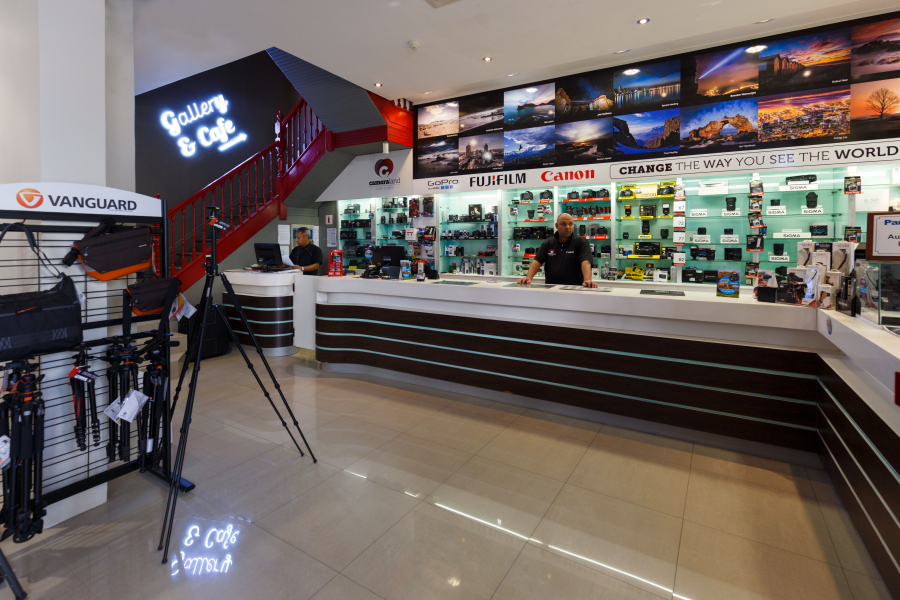
Cameraland: 68 Long St | www.cameraland.co.za | 021 423 4150
Incredible Connection: Shop 7, ENS House, Lower Loop St | www.incredible.co.za | 021 441 2420
Computer Mania: Cnr Long & Strand streets | www.computermania.co.za | 021 423 0717
iFix: 161 Loop St | http://ifix.co.za | 021 837 9800
Met-Tronics: 68 Bree St | www.met-tronics.com | 021 424 6572
Find more here: www.capetownccid.org/explore/shop
Looking ahead
Seven ways the CBD could become even smarter

1. Bicycle-sharing systems
Bike-share schemes, available in over 700 cities, allow citizens to borrow a bicycle from one point and return it to another. With the advent of IT, used in reservations and tracking, such systems became viable in the 21st century.
2. Pedestrian-powered street lights and solar-panels on roads
Las Vegas is expected to install kinetic pads into its sidewalks and roads that convert pedestrian steps into power. Similarly, France plans to install solar panels on roads to feed into the national grid.
3. Smart bins
A South Korean startup called Ecube has developed a solar-powered “smart bin” that allows cities to monitor the levels of waste in municipal bins. The technology predicts when a bin will be full and recommends when it should be emptied.
4. Augmented reality in property development
Augmented reality technology developed by VTT Technical Research Centre of Finland allows citizens to see how proposed construction projects could affect their neighbourhoods by superimposing 3D models into a real-time view of the built environment.
5. Apps that show parking spaces
A 2011 IBM study found that 30% of a city’s traffic is due to people hunting for parking. In some American cities, you can use an app to pinpoint the exact location of a vacant space.
6. Self-drive vehicles
Uber is launching a pilot fleet of autonomous Volvos in Pittsburgh. According to disruption theorist Tony Seba, driverless cars could reduce our need for parking bays because one vehicle can be used at different times by several people, keeping it moving on the road.
7. Drones deliveries
Amazon is working on Prime Air, a system designed to get packages to customers in 30 minutes or less using drones – not road vehicles. It is testing this in Canada, the United Kingdom and the Netherlands. Cape Town-based Signatura Property Development, inspired by a talk by local disruption theorist Dion Chang at the CCID’s business breakfast earlier this year, has begun looking into integrating drone landing pads in its new buildings.
Signatura’s managing director, David Cohen, sums up the impact such technology could have on our urban environment: “This goes hand in hand with our thinking regarding parking as a depreciating asset rather than an appreciating one. We think that technology is going to have a big impact on schemes in the next few years with some specific issues such as parking, access control and security being just a few that have come to mind.”