Cape Town’s “road to nowhere” finally has somewhere to go. And it could pave the way for a more equitable Central City.
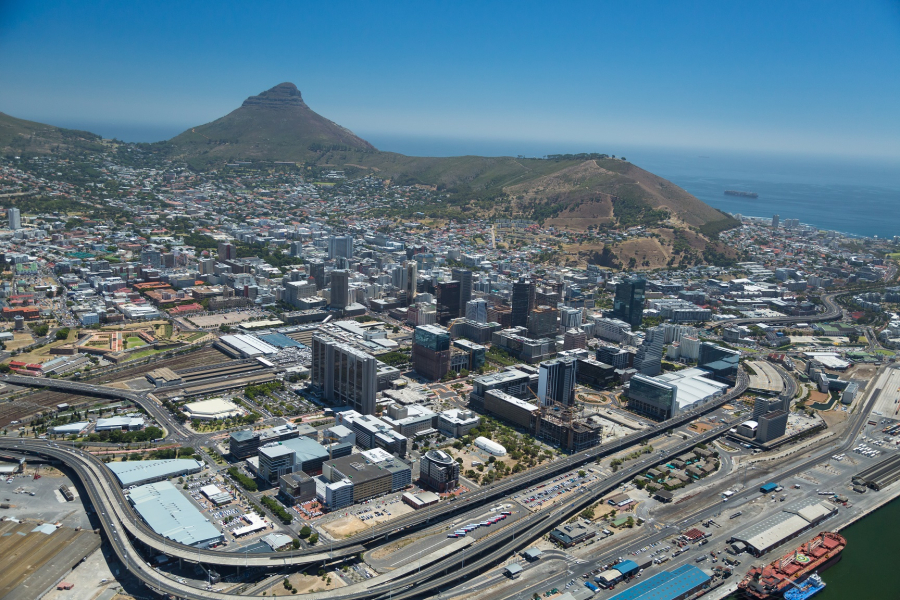
Never mind Table Mountain, Cape Town’s most famous landmark is arguably its Foreshore Freeway. This concrete monolith, which cuts the Central City off from the sea, features an elevated section as well as incomplete road “stubs”. It has been this way since construction halted in 1977, a monument to an era of car-centred urban planning. Surrounding the freeway, however, is six hectares of valuable, underused City-owned land.
Built on reclaimed land in the 1930s, the Foreshore itself is being reclaimed for a second time, as greenfields developments and refurbishments bring people to its streets. As the value of the precinct has increased, so has the urgency to “deal” with the freeway and surrounds, especially considering Cape Town’s status as the most traffic-congested city in SA (according to TomTom).
If completed, would the freeway solve this problem? Or is it time to look at it with new eyes? Proponents of so-called new urbanism cite the benefits of walkable neighbourhoods and globally advocate for the removal of such “overbuilt” infrastructure. There is even evidence to suggest doing so lessens traffic, a phenomenon known as “reduced demand” (the opposite of “induced demand”). The theory goes that if a road closes, travellers will adjust their behaviour to compensate – as long as there are alternatives.
To this end, in 2016, the City of Cape Town’s Transport and Urban Development Authority (TDA) launched the city’s first transit-oriented development (TOD) project, calling on investors and developers to submit proposals for the freeway and the surrounding land that would address the traffic congestion and make provision for affordable housing in the CBD. The aim was to reverse the legacy of apartheid spatial planning and bring people closer to places of work.
Six proposals made it through the initial assessment phase. The public could view these in an exhibition at the Civic Centre in March. Some of the proposals advocate for joining the freeway’s unfinished viaducts, while others opt for demolition of all its existing infrastructure. In the case of the latter, an at-grade boulevard or a tunnelled roadway could serve as an entryway into – and route through – the Central City. Along with affordable housing in the area, other ideas also include green spaces, sports facilities and public transport infrastructure that could transform the Foreshore into a vibrant people-focused node.
This is by no means a world first. In fact, freeways are literally falling out of favour all over. One of these was San Francisco’s Embarcadero Freeway, damaged by the 1989 Loma Prieta earthquake and then demolished. A new downtown emerged from the rubble, one that now has huge amounts of public space, as well as paths dedicated to cyclists and pedestrians. There are also new public transport routes, which have changed the way San Franciscans interact with their city.
Could demolition of Cape Town’s Foreshore Freeway, as mooted by a few of the proposals, result in the same for the Mother City? A similar project has transformed downtown Seoul, South Korea. The removal of the elevated Cheonggye Freeway reconnected the city with a lost waterway. According to Inhabitat, the area is now a “green oasis in a concrete jungle [...] that attracts 60 000 visitors a day”.
Other examples include the John F Fitzgerald Expressway in Boston, Massachusetts, in the US, and Rio Madrid in Spain’s central capital, where freeway traffic now goes into underground tunnels. All these projects have led to healthier, greener, and safer cities. Demolition may not be necessary, however, to overhaul the freeway. Another option is to go the way of the New York High Line, as raised by another of the proposals. This 2km linear park in Manhattan occupies an elevated section of a disused railway spur. The project, in addition to being a spectacular public space, has also catalysed development in the surrounding neighbourhoods. Could this be a way to reconnect the Cape Town CBD with the sea?
The City of Cape Town is now evaluating the public’s comments on the proposals as part of a four-month process that will result in the selection of the preferred bidders for the development. Councillor Brett Herron, the mayco member for TDA, says the City would like to see the planning and approval processes concluded within two years. Whatever the outcome, it’s sure to be a new way forward for Cape Town.