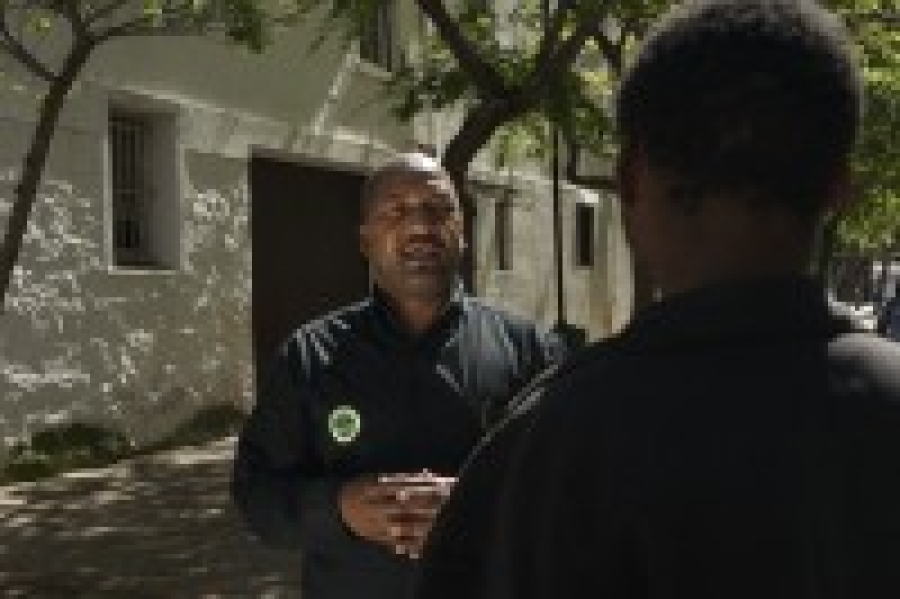
The Cape winter can be merciless for even the toughest Capetonians, but for people living on the streets, it makes their daily battle even more of a challenge.
Tough economic times and the lure of moving to a CBD where streets are paved with supposed opportunities draws countless people to downtown districts around the world. Likewise, here in Cape Town, we see people arriving, desperate not so much to make their fortune but even just to scrape together enough to support their families.
Sadly, some of these people find themselves on the street where it becomes increasingly difficult, day by day, for them to reintegrate themselves into a traditional lifestyle. We have many people with us in the Cape Town CBD, for example, who we refer to as the chronic homeless, living as they have on the streets already for many years.
A survey conducted a few years ago, in collaboration with the Cape Town Partnership, the City of Cape Town and the Cape Town Central City Improvement District (CCID), revealed that around 560 people are currently living on the streets of the CBD and immediate surrounds.
This number, when heard for the first time, sounds shocking but the reality is that the situation has actually remained constant for a number of years now.
The need to help street people, particularly the chronically homeless, is a real challenge that faces every downtown in the world, and there are many Capetonians who are sympathetic to the plight of street people; but for those of us involved in social development it becomes intensely personal, as each street person (to us, they are our clients) carries with them a very personal tale of struggle, desperation and frequently experience emotional, physical and substance abuse.
Children often end up on the street after running away from an abusive family life to seek relative safety on the streets. When relationships break down, one partner is often forced to move out with no place to live – and in many cases this is a woman. Others find themselves on the streets as a result of physical or mental health problems. Others still have been in prison and are discharged directly onto the streets, where opportunities for reintegration into society and a legitimate lifestyle are few and far between.
Street people the world over are often labelled as alcoholics or drug addicts, and while many street people become caught up in cycles of substance abuse, this is often the result of their life situation, not the cause of it – a way to cope with being on the street. A big city may seem to offer the attraction of many things, but ways in which street people can make a decent living are few and far between and the income derived is minimal. A vicious cycle is created in which few street people are ever able to earn enough (or upskill themselves sufficiently) to escape from their predicament. Feeding someone for a day does not help them tomorrow, so the work that is done by non-governmental organisations and social services in trying to assist people with a hand up rather than a hand out is critical if these cycles are ever to be broken.
The essential social ingredient that these organisations require is for the public to understand the need to give responsibly. This is particularly relevant when it comes to children, for whom the necessary legal procedures (in terms of the Children’s Act) and thus the social services and systems are in place to either reunite a child with his or her family when possible or, when not, to assist them to a place of safety.
The solution, however, is not that straightforward for adults as the agreement to be helped in any way must willingly come from the individual. Where a window of opportunity does lie is when the individual has only recently found themselves on the street (for example, after a marital breakup or loss of a job), and the early intervention by a fieldworker or social worker can make all the difference in the world to set that person back on course.
This situation is, however, the exception and not the rule and the work of anyone involved in social development and dealing with street people is challenging at the best of times. The NGOs we work with as well as the services provided by government are stretched beyond capacity. For example, there are more than 30 fieldworkers throughout the metropole all competing with each other just to find bed space in shelters. There is a critical shortage of shelter accommodation to assist even the most willing clients and the current number of beds available at any one time does not meet the needs of people living on the streets. And even when beds are found, they could be far away from the people who need them. For example, an occasional bed space may be free in Paarl or Ceres, but this does not help someone on the streets of the Central City who sees Cape Town as being their home.
Then there are also the challenges around the issues of human rights, and understanding basic truths such as the fact that it is not illegal to be poor and we cannot criminalise poverty. It’s also about understanding that not all homeless beg, nor are all people who beg homeless. There are Big Issue and other vendors, car guards and many others who earn money through other legitimate means but who also live on the streets. Plus there is the challenge that every caring person must face, at that point in time when someone who is clearly in need asks you for your small change: do you give directly as a handout, or do you give instead via campaigns such as GIVE RESPONSIBLY that support the incredible work done by the NGOs who help the homeless? The CCID’s own version of this campaign directly benefits six NGOs with whom we work directly in the Cape Town CBD, and who deal with both children and adults. We would encourage Capetonians who care to support the work these organisations do in trying to give a hand up rather than a hand out.
Pat Eddy is the CCID’s Social Development manager and a registered social worker.
To GIVE RESPONSIBLY within the Cape Town CBD, you can donate R10 each time you SMS “DREAM” to 38088, and six local NGOs will benefit (www.giveresponsibly.co.za).